
 24/7 Emergency Service
Smart thermostats have officially moved past “set it and forget it.” In 2026, the best systems feel less like a single wall control and more like a comfort platform—one that coordinates your HVAC equipment, indoor air quality (IAQ) devices, and even your home’s daily rhythm. The result is better comfort with less energy waste, plus cleaner air that’s managed proactively instead of reactively.
Comfort Settings Are Getting More Personal
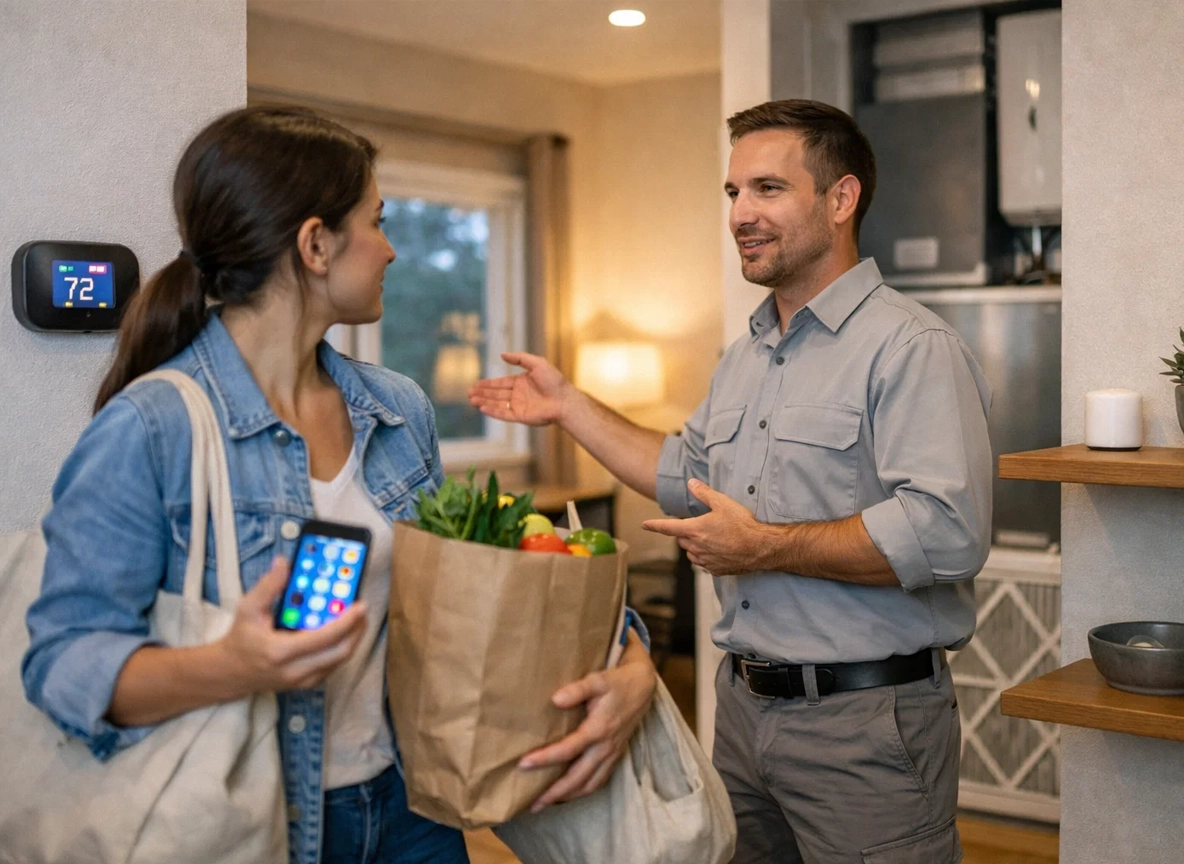
Modern thermostats are leaning into “comfort profiles” that go beyond basic heat/cool schedules. Instead of one temperature target for the whole home, homeowners increasingly expect room-by-room tuning, smarter fan behavior, and modes built around real-life needs: sleep comfort, pet comfort, allergy relief, work-from-home stability, and humidity-focused settings.
Thermostats are also getting better at avoiding the classic problem of “comfortable, but clammy” in summer or “warm, but dry” in winter by coordinating heating/cooling with humidity control—especially when paired with variable-speed systems and modulating equipment.
Another trend: Geofencing! Your smart thermostat can now detect when you’re home based on your phone’s Wi-Fi usage, so it can automatically turn the heat up or down when you arrive without you lifting a finger.
Energy Savings From Smarter Runtimes
Energy savings in 2026 isn’t only about turning the thermostat down. It’s about running HVAC equipment at the right intensity, for the right duration, at the right time. Thermostats are increasingly optimized for variable-capacity heat pumps and high-efficiency furnaces, using longer, lower-power cycles to maintain comfort instead of short bursts that waste energy. Expect more “energy dashboards” that translate runtime and efficiency into understandable insights—what changed, why your usage rose, and what action will matter most.
Utility-friendly features are also becoming mainstream. Many thermostats can participate in demand response programs, subtly shifting runtime to reduce peak load without making the home uncomfortable. Homes with solar and batteries benefit too: thermostats can pre-condition spaces when solar output is high, then coast later in the day. The bigger idea is simple—comfort is the goal, but timing and system behavior are the lever.
HVAC and IAQ Integration
One of the biggest home automation trends for 2026 is the tighter link between HVAC and IAQ. Thermostats are increasingly acting as coordinators for filtration, ventilation, humidifiers/dehumidifiers, and air purification. Instead of treating air quality as a separate gadget, systems can respond to conditions in real time: boost ventilation when airflow is required, run filtration after cooking, manage humidity to reduce mold risk, or circulate air to even out temperature and particle levels.
The most useful integrations are also context-aware. If outdoor air quality is poor, ventilation strategies may shift—filter more, ventilate less, or ventilate at safer times. If humidity climbs, dehumidification can take priority even if the temperature seems fine. For homeowners, it means fewer manual decisions and a home that feels consistently comfortable and “fresh,” not just warm or cool.
What’s Next?
As smart homes mature, thermostats are becoming the hub for comfort, efficiency, and health. In 2026, the winners won’t just be devices with nicer screens—they’ll be systems that coordinate HVAC and IAQ seamlessly, give homeowners clear control, and save energy without asking anyone to sacrifice comfort to get it.
Schedule an appointment with Fulkerson Plumbing & Air Conditioning to discover how your thermostat can start working for you!
 575-622-1600